In the golden sands of Egypt, where the Nile breathes life into the desert, the legacy of the pharaohs is etched not only in stone but in the shimmering allure of their jewelry. Among the most captivating of these ancient adornments are the scarab beetle and the Eye of Horus, symbols that transcended mere decoration to embody profound spiritual beliefs, power, and protection. These artifacts, crafted with astonishing skill and reverence, offer a window into a civilization where art and divinity were inextricably linked.
The scarab, or kheper as known in ancient Egyptian, was far more than an insect; it was a potent symbol of transformation, resurrection, and the sun's cyclical journey. The Egyptians observed the dung beetle rolling its ball across the earth, seeing in this humble act a metaphor for the sun god Ra pushing the solar disc across the sky. This connection to creation and rebirth made the scarab a favorite amulet among both royalty and commoners, believed to grant protection in life and safe passage into the afterlife. Pharaohs often incorporated scarabs into their jewelry, such as in pectorals, rings, and bracelets, using them as seals or inscribed with spells from the Book of the Dead to ensure their potency.
Similarly, the Eye of Horus, or wedjat, held immense significance in Egyptian mythology. It represents the eye of the falcon-headed god Horus, which was torn out in a battle with his uncle Seth and later restored by the god Thoth. This myth imbued the symbol with meanings of healing, wholeness, and protection. The eye was not just a spiritual emblem; it was also a mathematical symbol, with its parts representing fractions used in measuring quantities of grain and land. Adorning jewelry with the Eye of Horus was believed to ward off evil, promote health, and invoke the watchful protection of the gods, making it a ubiquitous feature in amulets, crowns, and royal regalia.
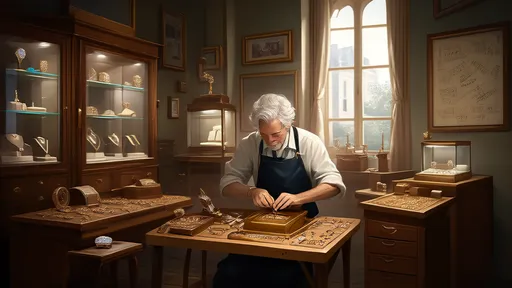
The creation of these magnificent pieces was a testament to the advanced craftsmanship and artistic vision of ancient Egyptian jewelers. Artisans, often working in temple workshops, employed a variety of sophisticated techniques. Lost-wax casting was commonly used for intricate designs: a model was carved in wax, covered in clay, and then heated to melt the wax away, leaving a mold into which molten gold or silver was poured. For inlay work, such as that seen in the famous burial mask of Tutankhamun, stones like lapis lazuli, turquoise, carnelian, and feldspar were carefully cut and set into cloisons formed by soldered wires, a technique known as cloisonné.
Materials were chosen not only for their beauty but for their symbolic properties. Gold, believed to be the flesh of the gods, was prized for its incorruptibility and luminosity, associating the pharaoh with the eternal and divine. Lapis lazuli, imported from Afghanistan, evoked the night sky and the heavens, while turquoise symbolized joy and life, and carnelian represented the blood of Isis and offered protection. The use of these materials transformed jewelry into a medium of spiritual expression, each piece a microcosm of the cosmos as perceived by the ancients.
Beyond their aesthetic and symbolic roles, these jewels served practical and political functions. Scarabs were often used as seals, engraved with the names and titles of pharaohs to authenticate documents and mark ownership. They were also placed over the heart of the mummified deceased, inscribed with spells to prevent the heart from testifying against its owner in the afterlife judgment. The Eye of Horus amulets were commonly placed within mummy wrappings to ensure regeneration and safety in the underworld. In life, such jewelry displayed wealth, status, and divine favor, reinforcing the pharaoh's role as the intermediary between the gods and the people.
The enduring fascination with Egyptian royal jewelry continues to captivate historians, archaeologists, and enthusiasts alike. Discoveries like the tomb of Tutankhamun have unveiled breathtaking examples that highlight the sophistication of ancient techniques and the depth of their symbolic language. These pieces are not mere relics; they are narratives in gold and gemstone, telling stories of belief, power, and the human desire to touch the eternal. They remind us that in the hands of Egyptian artisans, jewelry became a language unto itself—one that spoke of the cosmos, the divine, and the timeless journey of the soul.
In studying these ancient treasures, we uncover more than artistic achievement; we glimpse the worldview of a civilization that saw the material and spiritual worlds as deeply intertwined. The scarab and the Eye of Horus, masterfully crafted and rich with meaning, remain powerful icons of Egypt's legacy, echoing through millennia as testaments to humanity's enduring quest for meaning and beauty.
By /Aug 27, 2025
By /Aug 27, 2025
By /Aug 27, 2025

By /Aug 27, 2025
By /Aug 27, 2025

By /Aug 27, 2025

By /Aug 27, 2025

By /Aug 27, 2025
By /Aug 27, 2025
By /Aug 27, 2025
By /Aug 27, 2025
By /Aug 27, 2025
By /Aug 27, 2025
By /Aug 27, 2025

By /Aug 27, 2025
By /Aug 27, 2025
By /Aug 27, 2025
By /Aug 27, 2025
By /Aug 27, 2025

By /Aug 27, 2025
