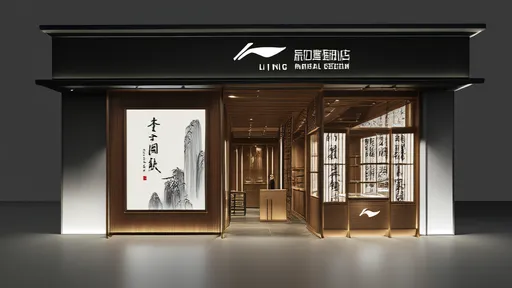
In the heart of Paris’s fashionable Le Marais district, a striking new storefront has been drawing crowds since its debut last autumn. The bold red signage with Chinese calligraphy-inspired typography announces the arrival of Li-Ning, China’s iconic sportswear brand, marking a strategic leap in its global ambitions. The two-story flagship, occupying a prime 800-square-meter space, represents more than just a retail expansion—it’s a cultural statement and a masterclass in how homegrown brands can redefine their identity for international audiences.
The store’s design immediately sets it apart from Western sportswear giants. Instead of the usual industrial aesthetics, Li-Ning’s Paris outpost blends contemporary minimalism with subtle Eastern motifs. The interior features bamboo-textured paneling, terracotta tile accents reminiscent of Chinese courtyards, and digital art installations showcasing tai chi movements. This deliberate fusion creates what the brand calls "East-meets-West athleticism"—a theme that extends to the product displays. Signature sneakers like the Way of Wade series sit alongside Paris-exclusive apparel collections featuring muted tones and tailored silhouettes, a departure from the vibrant colorways popular in Asian markets.
Local consumers have responded with unexpected enthusiasm. French sneakerhead Julien Moreau, waiting in line for a limited-edition drop, remarked, "They’re not trying to be Nike or Adidas. The designs have this unfamiliar freshness—like when Japanese streetwear first hit Paris in the 90s." This sentiment echoes across fashion forums where the brand’s "China-chic" aesthetic has become a talking point. Industry analysts note Li-Ning’s shrewd positioning: premium but not luxury, distinctly Chinese yet globally relatable. The pricing strategy reflects this balance, with shoes averaging €120-180—20% below comparable Nike tiers but commanding higher perceived value than European fast-fashion sports lines.
Behind the scenes, Li-Ning’s Paris team operates with remarkable autonomy. Unlike traditional Chinese expansions that rely heavily on expat staffing, the flagship is predominantly run by French retail veterans recruited from Galeries Lafayette and Le Coq Sportif. "Our mandate was clear: adapt without diluting," explains store director Camille Laurent. This approach manifests in everything from the curated playlist featuring Chinese electronica artists to the tea bar serving oolong-infused protein shakes—a far cry from the corporate cookie-cutter international stores typical of global chains.
The brand’s digital strategy reveals equal sophistication. Rather than blanket social media campaigns, Li-Ning has micro-targeted Parisian subcultures through collaborations with local parkour groups and dance crews. Their guerrilla marketing stunts—like projecting 3D dragon animations onto Haussmann-era buildings—generate organic viral content while avoiding the "try-hard" stigma that often plagues Asian brands abroad. Early data suggests this grassroots approach is working: 68% of opening-month customers were French (not tourists or diaspora), with repeat visitation rates surpassing industry averages.
Supply chain innovations enable this overseas push. Unlike Western competitors reliant on Asian manufacturing, Li-Ning leverages its domestic production base for rapid response. The Paris store receives biweekly shipments of small-batch designs, allowing quicker rotation than competitors’ seasonal cycles. This agility proved crucial when a cheongsam-inspired training set worn by a French influencer sold out within 72 hours—replenishment arrived before hype faded. Such operational flexibility stems from Li-Ning’s vertically integrated ecosystem, a legacy of China’s manufacturing evolution that now doubles as a global competitive edge.
Financial analysts observe that the Paris experiment is reshaping Li-Ning’s entire corporate strategy. Whereas previous international attempts focused on budget-conscious Southeast Asian markets, the European foray has boosted gross margins by 4.5 percentage points. More significantly, the brand’s domestic perception has transformed—Chinese millennials now view Li-Ning as a badge of cultural pride rather than a utilitarian purchase. This halo effect has lifted same-store sales in mainland China by 18%, proving that successful globalization can reverberate back home.
Yet challenges persist. Some European buyers still associate Chinese brands with copycatting, a stereotype Li-Ning combats through transparent design storytelling. In-store tablets detail the cultural references behind each collection, from Tang dynasty prints to Shaolin monk robes. The brand has also joined the Sustainable Apparel Coalition, preempting criticism about environmental standards—a sensitive area for Western consumers. "We’re not hiding our origins," asserts Li-Ning’s global creative director. "We’re redefining what ‘Made in China’ represents in premium sportswear."
As other Chinese brands watch Li-Ning’s progress, industry watchers speculate whether this marks the beginning of a broader shift. The Paris flagship’s success suggests that globalization no longer requires Western mimicry—instead, it rewards confident cultural specificity paired with localized execution. With rumors of a London location in 2024, Li-Ning seems poised to test this hypothesis further. Its journey from domestic champion to global contender offers a playbook for Asian brands: honor your roots, empower local teams, and let product authenticity—not pricing gimmicks—drive the narrative.
The Le Marais store’s most telling detail might be its changing room mirrors, which display a subtle Li-Ning logo alongside the Mandarin characters for "movement" and "flow." It’s a small touch that encapsulates the brand’s philosophy: global visibility need not erase cultural identity. In an era of homogenized retail, that distinction could prove revolutionary—one flagship at a time.

By /Aug 1, 2025
By /Aug 1, 2025

By /Aug 1, 2025

By /Aug 1, 2025

By /Aug 1, 2025
By /Aug 1, 2025

By /Aug 1, 2025
By /Aug 1, 2025

By /Aug 1, 2025
By /Aug 1, 2025
By /Aug 1, 2025

By /Aug 1, 2025

By /Aug 1, 2025

By /Aug 1, 2025
By /Aug 1, 2025

By /Aug 1, 2025
By /Aug 1, 2025
By /Aug 1, 2025

By /Aug 1, 2025

By /Aug 1, 2025
